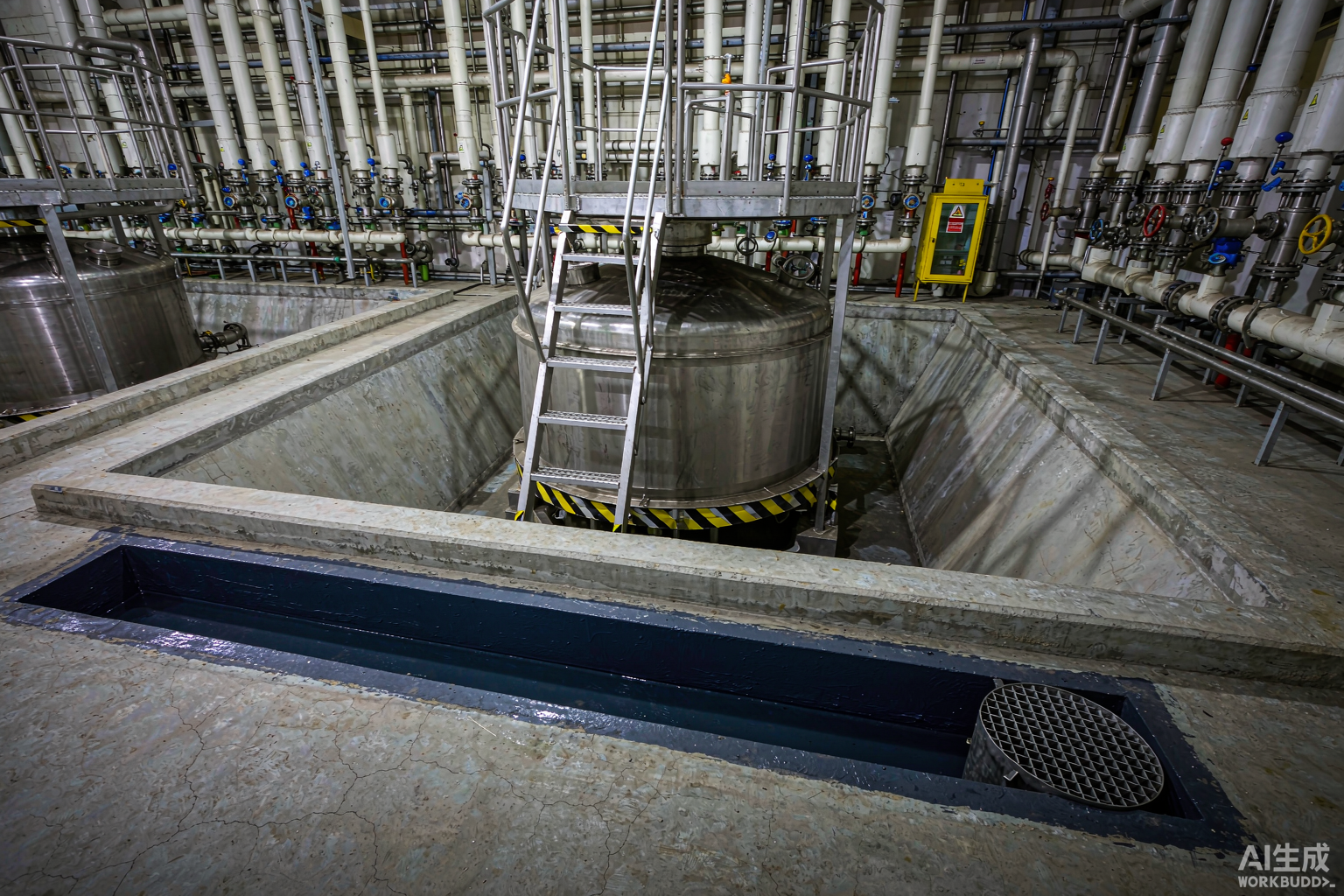
A question we hear often from plant managers: why do the floors, equipment foundations, bunds and trenches in a chemical workshop start spalling, hollowing and leaking after only a few years — sometimes even leaving the concrete substrate crumbly and softened?
The root cause is media penetration
Once a corrosive waste liquid — sulfuric acid, hydrochloric acid, hydrofluoric acid and the like — seeps through a damaged point, it drives concrete carbonation and strength loss. A 50% sodium hydroxide solution softens and flakes the surface. Organic solvents such as acetone and toluene swell and delaminate an ordinary epoxy coating. Hot liquid leaks at 80–120°C make a standard epoxy blister almost instantly.
Industry: anti-corrosion flooring enters a stock-upgrade phase
GEP Research reports that the global anti-corrosion flooring market reached about US$8.72 billion in 2025, with chemical and petrochemical remaining the dominant end-use segments; solvent-free and high-solid systems already account for over half of shipments. GB 30981.2-2025, effective June 2026, further tightens the VOC limit for industrial anti-corrosion coatings to solvent-free ≤30 g/L — greening is now a hard constraint, not an option.
JIANBANG's approach: treat by media and by zone
We specify the coating system only after the working conditions are surveyed — clarifying the media type and temperature first, then matching the system, so that "repair every year" becomes "do it right once."
From survey to system
- Floors & bunds under long-term 98% H₂SO₄ / HCl immersion → 100% solid, zero-solvent JB-98 heavy-duty acid-resistant coating (720 h @ 98% H₂SO₄, no blister).
- HF / nitric acid environments → JB-406 special-acid-resistant coating.
- Strong-alkali & solvent zones → JB-8866 ultra chemical-resistant coating.
- High-temperature hot-liquid scour → JB-800 ultra-high-temp coating (up to 1200°C, 800°C quench without peeling).
Survey the conditions first, define the media and temperature, then match the coating system — that is how a chemical-plant floor stops failing year after year.
Need a floor coating system for your plant?
Tell us your media, temperature and substrate — our 26-year technical team matches the system and sends free samples for on-site testing.